Forest Bathing with Essential Oils: Bringing Shinrin-Yoku Indoors

Table of Contents:
- Introduction
- What Is Forest Bathing (Shinrin-Yoku)?
- What Does Research Say About the Benefits of Forest Bathing?
- Forest Bathing Is a Multisensory Experience
- Phytoncides, Forest VOCs and Essential Oils
- Can Essential Oils Recreate Forest Bathing Indoors?
- Why Getting to a Forest Is Not Always Possible or Practical
- Realistic Safety Concerns About Going Into a Forest Alone
- Best Essential Oils for an Indoor Forest Bathing Practice
- Best Ways to Use Essential Oils for Indoor Forest Bathing
- Creating a Multisensory Indoor Forest Experience
- Combining Forest-Inspired Aromatherapy With Indoor Exercise
- A Simple Indoor Forest Bathing-Inspired Practice
- Featured Forest-Inspired Essential Oil Blend
- Essential Oil Safety and Important Limitations
- Frequently Asked Questions
- References
Introduction
Walking slowly beneath a canopy of trees, noticing the movement of leaves, listening to birds and breathing in the natural aroma of the forest can feel deeply restorative.
I personally love how balanced I feel after spending time in wooded areas. I often come away feeling both refreshed and invigorated, yet also calmer and more relaxed.
In Japan, the practice of intentionally spending time immersed in a forest atmosphere is known as shinrin-yoku, a term commonly translated into English as forest bathing.
Forest bathing does not involve taking a bath, swimming or using water. It refers to spending unhurried time in a forest or other wooded environment while paying attention to what we can see, hear, smell, touch and otherwise experience around us.
For those of us who practice aromatherapy, it is natural to wonder whether essential oils can help us capture some of the sensory qualities of forest bathing when we are indoors.
Conifer essential oils, in particular, can provide aromas that strongly evoke pine needles, fir trees, spruce forests, cedarwood, junipers and cypress. See AromaWeb's Conifer Essential Oil Guide for an extensive introduction to these oils.
However, there is an important distinction to make at the beginning of this guide: diffusing a conifer essential oil is not the same thing as spending time in an actual forest. A real forest provides a complex, constantly changing combination of aromas, light, sound, air movement, temperature, visual depth, plants, microorganisms, terrain and other sensory experiences.
Essential oils can help support the aromatic portion of a forest-inspired experience, but they cannot reproduce the entire forest environment.
This AromaWeb guide explores what forest bathing is, what research currently suggests about its benefits and how essential oils can be used mindfully to bring some of the aromatic and sensory qualities of the forest indoors when getting outdoors is not possible, practical or desirable.
What Is Forest Bathing (Shinrin-Yoku)?

The Japanese term shinrin-yoku is generally translated as "forest bathing" or "taking in the forest atmosphere."1,2,4 The term was coined in Japan in 1982 by Tomohide Akiyama of the Japanese Forestry Agency as part of an effort to encourage people to leave the city and spend more time in forests.1,4
Shinrin-yoku is not primarily about how far you walk, how many calories you burn or how quickly you move. Dr. Qing Li describes it as connecting with nature through the senses rather than simply hiking, jogging or exercising in the forest.4
Jennifer Peace Rhind similarly emphasizes the multisensory nature of shinrin-yoku, noting that our senses do not work in isolation and describing the combined influence of forest scenery, natural sounds and scent.3
A traditional forest bathing experience can include walking slowly, sitting quietly, noticing the scent of trees and earth, listening to wind and water, observing light and color and touching safe natural textures such as bark or leaves. There is no need to accomplish a particular distance or athletic goal.
The terms forest bathing, shinrin-yoku, forest therapy and nature therapy are sometimes used interchangeably. They overlap, but they are not always identical. Forest therapy may refer to a more structured or guided practice, while shinrin-yoku can be practiced informally and independently.
What Does Research Say About the Benefits of Forest Bathing?
Research into forest bathing has examined psychological well-being, stress, mood, heart rate, blood pressure, autonomic nervous system activity and immune markers. The overall findings are promising, particularly for short-term relaxation and emotional well-being, but the research is not strong enough to treat forest bathing as a medical treatment.
A 2026 systematic review and meta-analysis found that forest bathing was associated with short-term reductions in heart rate, tension-anxiety, depression-despondency and several other negative mood measures. However, the researchers rated the certainty of the evidence as very low, mainly because of risk of bias, inconsistency and imprecision across the available studies. They concluded that forest bathing should be viewed as a potential complementary practice for health promotion rather than as a stand-alone preventive or therapeutic intervention for cardiovascular or mental health conditions.6
That distinction is important. A peaceful walk in a forest may help you feel calmer, more refreshed or more connected to nature, but forest bathing should not replace appropriate medical or mental health care.
Salvatore Battaglia discusses shinrin-yoku and related psychological and physiological research in both Aromatree and The Complete Guide to Aromatherapy Third Edition Volume 3 - Psyche & Subtle. In both books, he considers forest bathing within a broader exploration of biophilia and our connection with the natural world.1,2
Forest Bathing Is a Multisensory Experience
One reason it is difficult to reproduce forest bathing indoors is that a forest stimulates far more than the sense of smell.
A forest can provide layers of visual green, changing patterns of sunlight and shadow, depth and distance, the sound of birds or moving water, wind moving through leaves, the aroma of trees and soil, variations in temperature and humidity and the tactile experience of walking over natural terrain.
A scientific review of forest volatile organic compounds specifically cautions against attributing the benefits of a forest visit to forest aromas alone. The authors conclude that forest exposure involves an integrated stimulation of the senses and note that the visual component may play a particularly important role.5
This is encouraging for those who need to remain indoors because it suggests that an indoor forest-inspired practice does not need to focus only on essential oils. Aroma can be combined with nature imagery, forest sounds, lighting and gentle air movement to create a more complete sensory experience.
Phytoncides, Forest VOCs and Essential Oils
The word phytoncide appears frequently in books and articles about shinrin-yoku. It is often used to describe substances released by trees and other plants into the surrounding air.
In aromatherapy and forest bathing literature, phytoncides are sometimes described loosely as aromatic substances or essential oils released by forest trees. The scientific terminology is more complicated. The term phytoncide has been used for a broad range of plant-derived substances, including both volatile and nonvolatile compounds. Because of the potential for confusion, the authors of one scientific review prefer the more specific term forest volatile organic compounds or forest VOCs when discussing the volatile compounds present in forest air.5
Forest air can contain monoterpenes and other volatile compounds that are familiar to aromatherapists. Alpha-pinene, beta-pinene, limonene and camphene are among the forest VOCs commonly discussed in the research literature.5 These constituents can also occur in conifer essential oils.
This overlap does not mean that essential oil diffusion duplicates exposure to forest air. Although essential oils contain some of the same volatile compounds found in forest air, they are not chemically identical to naturally occurring forest VOCs. Researchers note that not all forest BVOCs are present in essential oils and that some compounds found in essential oils can result from the distillation process itself.5
The composition and concentration of forest VOCs also varies considerably according to factors such as tree species, season, weather, sunlight, altitude and time of day.5
This distinction allows us to appreciate why conifer essential oils can smell convincingly forest-like while still being realistic about what indoor aromatherapy can and cannot recreate.
Can Essential Oils Recreate Forest Bathing Indoors?
Not exactly. Essential oils cannot fully reproduce forest bathing. They can, however, help recreate one important part of the experience: the aroma of trees and a personal association with wooded environments.
The idea of using forest-derived essential oils indoors when direct access to a forest is not possible has also been discussed by Dr. Qing Li and within aromatherapy literature.1,2,4
There is also preliminary research showing that inhalation of certain conifer-derived essential oils can be associated with measurable short-term responses. For example, a small human study reported physiological relaxation following brief olfactory exposure to Hinoki Cypress (Chamaecyparis obtusa) leaf oil.7 Another small study involving 26 university students found that brief exposure to a fir essential oil was associated with improvements in several, though not all, mood measures and lower state anxiety compared with exposure to room air.8
These studies are interesting, but they should not be generalized to every conifer essential oil or interpreted as evidence that any essential oil can reproduce the effects of spending time in a forest.
A 2026 randomized crossover study compared 40 minutes in a real forest with a 40-minute indoor 360-degree forest simulation that included recorded forest sounds and the diffusion of spruce needle essential oil (the botanical name was not supplied). Participants reported some temporary calming effects from the simulated environment, and heart rate decreased during both conditions. However, the real forest produced significantly greater improvements in subjective well-being and significantly greater reductions in state anxiety and heart rate. The study randomized 49 highly sensitive adults, with 48 included in the intention-to-treat analysis, so its findings cannot automatically be applied to everyone. Even so, the study provides a useful reminder that a real forest supplies sensory complexity that an indoor simulation cannot fully reproduce.9
Key Point: Think of essential oils and other indoor nature elements as ways to support a forest-inspired sensory practice, not as a scientifically equivalent replacement for being in a forest.
Why Getting to a Forest Is Not Always Possible or Practical
Recommendations to "just get outside" can overlook the realities that prevent many people from safely or comfortably accessing a forest. An indoor approach can be valuable during times when a forest visit is not realistic.
- Mobility limitations or disability: Uneven ground, steep grades, roots, mud and inaccessible trails can make wooded areas difficult or impossible to navigate.
- Chronic illness, pain or fatigue: A person may enjoy nature but not have the stamina or physical comfort needed for a forest walk.
- Lack of transportation or nearby forests: Many people live far from wooded areas or do not have a practical way to reach them.
- Weather and seasonal conditions: Extreme heat, cold, snow, ice, heavy rain and high humidity can make outdoor activity uncomfortable or unsafe.
- Wildfire smoke or poor outdoor air quality: There are times when remaining indoors is the healthier choice.
- Ticks, mosquitoes and other biting insects: Concern about Lyme disease, other tick-borne illnesses or painful insect bites can understandably reduce someone's comfort with spending time in wooded areas.
- Seasonal allergies or other environmental sensitivities: Pollen, mold or other outdoor exposures can make a forest visit unpleasant for some individuals.
- Time limitations: A person may simply not have the ability to travel to a forest when they need a restorative break.
- Personal safety concerns: Some people are not comfortable entering an isolated wooded area alone, particularly when trails are unfamiliar or sparsely used.
A small local park, garden or other green space can still provide meaningful contact with nature when a forest is unavailable. Dr. Qing Li also emphasizes that even a small green space can be worthwhile when a forest is not accessible.4
Realistic Safety Concerns About Going Into a Forest Alone
Forest bathing is usually described as peaceful and restorative, but that does not mean every forest setting is appropriate for every person.
Solo visitors may reasonably be concerned about getting lost, falling on uneven terrain, sudden weather changes, wildlife, poor cellular reception or being too far from help if a medical problem occurs. The comfort level of a particular trail can also change according to the time of day, how isolated the area is and whether other visitors are present.
Personal safety is also a legitimate consideration. Someone who does not feel comfortable entering an isolated forest alone should not feel that they must override that instinct in order to practice shinrin-yoku. A populated park, an accessible nature center, a garden or an indoor forest-inspired practice may be a better fit.
Forest bathing is intended to reduce stress, not create additional anxiety about personal safety.
Best Essential Oils for an Indoor Forest Bathing Practice
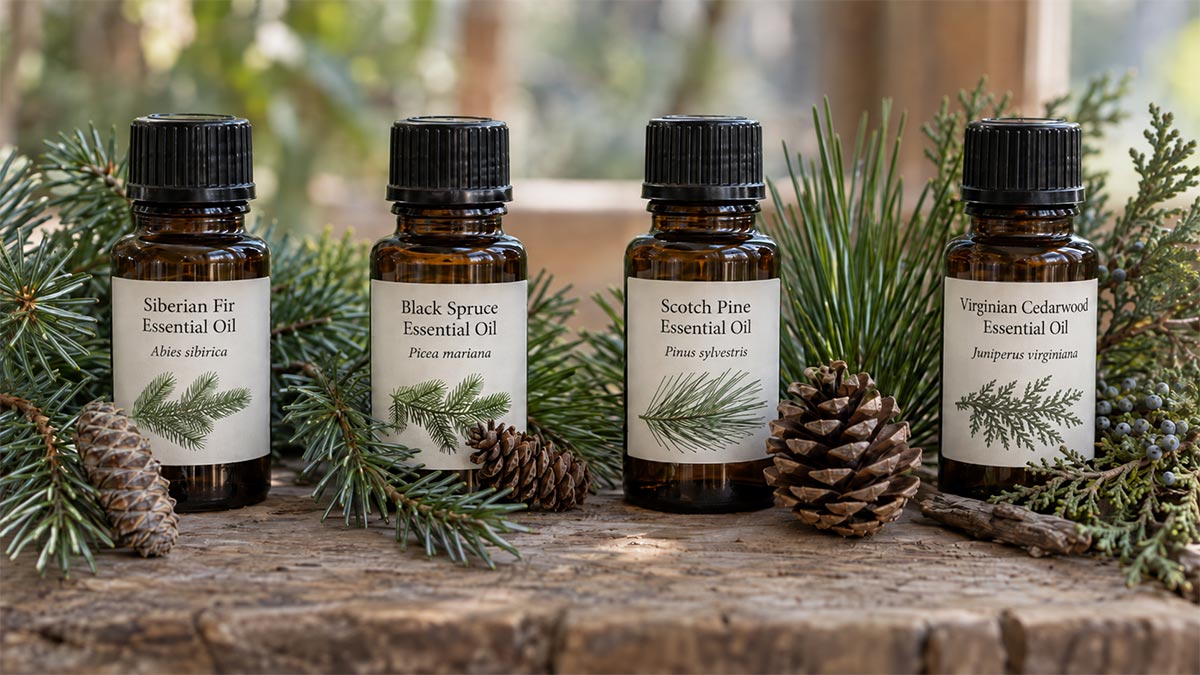
A forest does not have one universal aroma and shinrin-yoku is not limited to conifer forests. However, fir, spruce, pine, cypress, juniper and cedarwood essential oils are especially useful when the goal is to create an aroma that most people readily associate with wooded environments.
The following are useful aromatic directions to consider. The individual oil you prefer matters more than trying to create one supposedly "correct" forest aroma.
Comparing the Aromas of Selected Conifer Essential Oils
Conifer essential oils can differ considerably in aroma, even when they belong to the same genus. For example, one pine essential oil may smell quite different from another pine oil. The descriptions below are intended as general aromatic starting points for individual essential oils rather than descriptions of entire groups of conifers.
The aroma of a particular essential oil can also vary based on geographic origin, growing conditions, the plant material distilled, distillation methods, age, storage and other factors. Whenever possible, smell the specific essential oil that you are considering using rather than selecting it solely because it is identified as a fir, spruce, pine or other type of conifer.
| Essential Oil | Botanical Name | General Aromatic Character | Potential Aromatic Contribution |
| Siberian Fir | Abies sibirica | Fresh, crisp and distinctly coniferous | Provides a fresh, recognizable evergreen character without necessarily dominating a blend |
| Balsam Fir | Abies balsamea | Fresh, vibrant, crisp and coniferous | Adds a lively, fresh evergreen quality |
| Silver Fir | Abies alba | Fresh, woody, coniferous, earthy and sweet | Offers an evergreen aroma with a somewhat sweeter and earthier dimension |
| Black Spruce | Picea mariana | Fresh, crisp, woody and earthy | Adds a crisp forest character together with woody and earthy depth |
| Blue Spruce | Picea pungens | Bright, crisp, woody, earthy and slightly camphorous; it can also exhibit a subtle lemony quality | Can add brightness and aromatic lift while retaining a recognizable conifer character |
| Scotch Pine | Pinus sylvestris | Crisp, fresh and distinctly pine-like | Provides the familiar fresh pine character that many people associate with evergreen forests |
| Pinyon Pine | Pinus edulis | Fresh, crisp, woody and coniferous | Offers its own distinctive pine character and should not be assumed to smell like Scotch Pine simply because both belong to the Pinus genus |
| Virginian Cedarwood | Juniperus virginiana | Deep, woody and balsamic with a familiar cedar-chest character | Adds deeper woody character and can help give a blend the impression of trunks, bark and forest wood rather than needles alone |
| Texas Cedarwood | Juniperus deppeana | Dry, woody and pencil-like, with a somewhat rougher and more rugged character than Virginian Cedarwood | Adds a dry, rugged woody quality to forest-inspired blends |
| Cypress | Cupressus sempervirens | Fresh, herbaceous, woody and slightly coniferous | Introduces a fresh woody-herbaceous dimension that differs from the more familiar fir, spruce and pine aromas |
| Hinoki (Japanese Cypress) | Chamaecyparis obtusa | Aroma varies depending on whether the oil is distilled from the wood, root or needles/leaves. Hinoki Wood Essential Oil is woody and sweet. | Provides a distinctive Japanese conifer character. Hinoki leaf/twig oil is especially noteworthy because it has been used in human olfactory research examining physiological relaxation.7 |
| Juniper Berry | Juniperus communis | Crisp, woody, sweet and earthy with a subtle fruity note | Adds a distinctive sweet, earthy and subtly fruity conifer nuance rather than a conventional needle aroma |
Hinoki Essential Oil is particularly interesting in the context of forest-inspired aromatherapy because Hinoki leaf and twig oil has been studied in human olfactory research. In one small study involving 13 female university students, 90 seconds of exposure to the aroma of Hinoki leaf and twig essential oil was associated with reduced activity in the right prefrontal cortex and increased parasympathetic nervous activity compared with the control condition. Participants also rated the Hinoki aroma as significantly more comfortable than the control.7
However, this does not mean that Hinoki is necessary for creating a meaningful forest-inspired aromatic experience. Many other conifer essential oils can be selected according to their individual aromas, availability and sustainability.
The essential oils shown above are only a sampling of the many conifer oils available, and their aromas should be considered individually rather than assumed to be typical of an entire genus or conifer group. For more detailed information including botanical information, safety considerations and conservation status, refer to AromaWeb's Conifer Essential Oil Guide.
Sustainability matters when selecting forest-derived oils. Some tree species are threatened or endangered and some wood-derived essential oils require harvesting the wood itself. Review the conservation status and sourcing of each oil before purchasing it. You can find sustainability and conservation status information within each of AromaWeb's essential oil profiles.
Best Ways to Use Essential Oils for Indoor Forest Bathing
For an indoor practice inspired by shinrin-yoku, I generally prefer inhalation methods rather than topical application. The goal is to experience the aroma as part of the surrounding sensory environment.
Essential Oil Diffusion
Diffusion is especially useful when you want the forest aroma to become part of the room itself.
Use a small amount of essential oil and allow the aroma to remain subtle. A forest usually does not smell like a perfume counter and your indoor forest-inspired environment does not need to either.
Follow the instructions for your particular diffuser and do not exceed the manufacturer's recommended amount of essential oil. Diffuse in a well-ventilated space and use essential oils intermittently rather than continuously. AromaWeb's Essential Oil Diffuser Safety Tips provides additional guidance.
Personal Aromatherapy Inhaler
A personal aromatherapy inhaler is an excellent choice when you want the aroma to remain close to you rather than dispersing essential oil throughout a room. It is also useful when another person or a pet in the home should not be exposed to the oils you are using.
Personal inhalers work especially well when pairing aroma with a nature video, quiet meditation or indoor exercise because you can use the inhaler briefly when you want to reconnect with the forest-like aroma and then replace the cap.
Fragrance Test Strip or Scent Strip
A fragrance test strip offers an exceptionally simple, low-waste option. Add a drop of your selected essential oil or blend to the strip and keep it nearby. When you want to experience the aroma, raise the strip toward your nose and inhale gently.
This method gives you more control than whole-room diffusion and requires very little essential oil. See AromaWeb's Guide to Evaluating the Aroma of an Essential Oil for more information about fragrance test strips.
Creating a Multisensory Indoor Forest Experience

Because forest bathing is multisensory, essential oils may be more meaningful when they are combined with other gentle reminders of the natural world.
Visual Nature: Forest Videos, Photography and Greenery
Consider watching a high-quality forest walking video, a slow cycling video through a wooded area or a quiet recording of a stationary forest scene. Avoid videos with rapid cuts, excessive narration or distracting graphics if your goal is relaxation and sensory immersion.
There is research supporting the relaxing physiological effects of viewing natural scenery indoors. A systematic review of 37 articles found that the majority of studies using displayed nature stimuli, including photographs, videos, three-dimensional images and virtual reality, reported more physiologically relaxed responses when participants viewed natural scenery than when they viewed control scenes.10
If you prefer not to use a screen, a view through a window, forest photography, botanical artwork or indoor plants can add visual contact with nature.
Recorded Forest Sounds
Digital recordings of leaves moving in the wind, birdsong, a flowing stream or other forest sounds can add another sensory dimension. Keep the volume comfortable and realistic rather than making the soundscape louder than it would feel outdoors.
A 2021 systematic review identified 36 publications examining the potential health and well-being effects of natural sounds. A meta-analysis of 18 of those studies found that exposure to natural sounds was associated with improved health and positive affective outcomes and with reduced stress and annoyance compared with the conditions used for comparison.11
Gentle Air Movement
A small fan set to a gentle speed can provide subtle air movement that helps the room feel less static. This does not reproduce the chemistry or temperature variations of forest air, but the physical sensation of air moving across the skin can add another layer to the experience.
If you are also using a diffuser, position the fan so that it does not blow the diffuser mist directly toward your face.
Lighting
Lighting can also influence the atmosphere. Natural daylight can be ideal when it is available. Indoors, softer lighting or lighting that resembles warm daylight may feel more natural than harsh overhead illumination.
You can also experiment with gentle patterns of light and shadow, such as sunlight filtered through blinds or a forest video that naturally shows leaves and branches moving in the light. The goal is not to create a dramatic special effect. Subtle, comfortable lighting that helps you focus on the nature experience is enough.
Natural Materials and Texture
Wood, pinecones, smooth stones, houseplants and other natural materials can provide visual and tactile reminders of the outdoors. They do not need to be elaborate. A single meaningful natural object can be enough to help direct attention toward the sensory experience.
Reduce Digital Distractions
If you are using a television, computer or tablet for a forest video, consider silencing notifications and avoiding other multitasking. The screen can serve as a window into nature rather than another source of alerts and demands.
Combining Forest-Inspired Aromatherapy with Indoor Exercise
Traditional shinrin-yoku is not an exercise program. Its purpose is sensory immersion and connection with nature rather than athletic performance.
However, there is no reason that a forest-inspired indoor experience cannot accompany walking, running or cycling if that makes indoor exercise more enjoyable for you.
One of my favorite ways to use conifer essential oils is to use a personal inhaler or a scent strip while I am walking or running on my treadmill or using an exercise bike. I enjoy pairing the aroma with nature videos that simulate walking, hiking or cycling through a forest. This does not turn the workout into traditional shinrin-yoku, but it helps me create a more immersive and enjoyable connection with the type of outdoor environment that I would rather be moving through.
A forest soundtrack, gentle fan and softer lighting can add to the sensory experience. When using exercise equipment, safety comes first. Make sure that lighting remains bright enough to use the equipment safely and never let a video, inhaler or other sensory element distract you from your footing or the controls.
A Simple Indoor Forest Bathing-Inspired Practice
There is no required formula for practicing forest-inspired aromatherapy indoors. The following is one simple approach:
- Choose one conifer essential oil or a simple conifer blend that you enjoy.
- Use it in a diffuser, personal inhaler or on a scent strip. Keep the aroma pleasantly subtle.
- Select a forest view, photograph or slow-moving nature video.
- Add quiet forest sounds if they help you feel more immersed.
- Adjust the lighting so that the room feels comfortable and natural while remaining safe.
- If desired, use a gentle fan to create a small amount of air movement.
- Sit quietly, meditate, stretch, walk on a treadmill or use an exercise bike according to your own goals and abilities.
- Notice what you see, hear and smell without trying to force a particular emotional response.
Even a short, intentional session can provide a welcome pause from an overstimulating indoor routine. The purpose is not to perfectly imitate a forest. It is to create a personally meaningful sensory connection with nature using the resources that are available to you.
Featured Forest-Inspired Essential Oil Blend
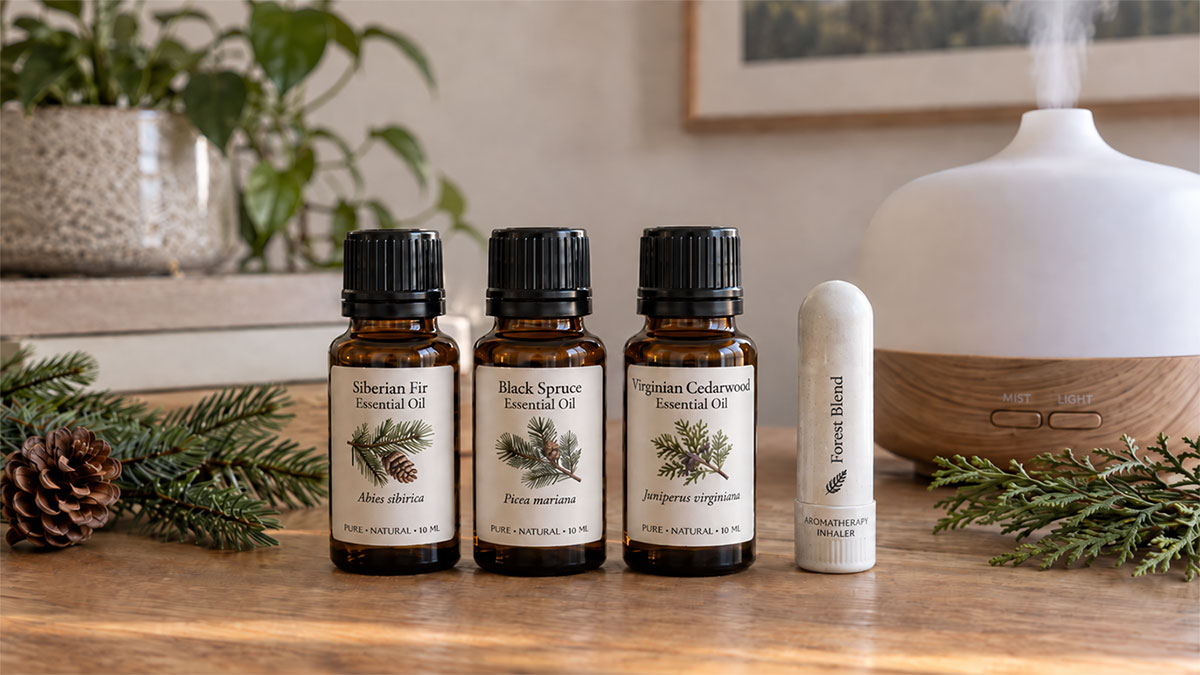
This simple blend combines the fresh, green character of fir and spruce with the deeper woody aroma of Virginian Cedarwood. It is intended for adult inhalation. Review the safety information for each oil before use, particularly if you are pregnant, have a medical condition, take medications or are sensitive to fragrance.
Forest-Inspired Essential Oil Blend
4 drops Siberian Fir Essential Oil
3 drops Black Spruce Essential Oil
3 drops Virginian Cedarwood Essential Oil
To Use in an Essential Oil Diffuser
Combine the oils in a small dark glass bottle if you would like to prepare the blend in advance. Add only the number of drops appropriate for your particular diffuser. You do not need to use all 10 drops at once.
Diffuse intermittently in a well-ventilated room. AromaWeb's Essential Oil Diffuser Safety Tips discusses why intermittent diffusion is preferable to continuous diffusion.
To Use in a Personal Aromatherapy Inhaler
Add the 10-drop blend to the wick of a personal inhaler and assemble the inhaler according to the manufacturer's directions. If you prefer a gentler aroma, use fewer drops or dilute the aromatic strength according to the guidance in AromaWeb's Aromatherapy Inhaler Guide.
To use, remove the cap, hold the inhaler close to one nostril without allowing it to touch the skin and inhale as deeply as is comfortable. Repeat with the other nostril if desired, then replace the cap. Do not inhale continuously.
To Use on a Scent Strip
Add one drop of the completed blend to a fragrance test strip. Keep the strip nearby and raise it toward your nose whenever you want to experience the aroma. This is an especially conservative way to use the blend.
Recipe Safety
Before using the blend, review the safety information for each essential oil and make sure each oil is appropriate for you. Immediately discontinue use if you experience irritation, headache, nausea, respiratory discomfort or any other adverse reaction.
Do not ingest this blend and do not apply it undiluted to the skin. Keep essential oils out of reach of children and pets. When diffusing, allow pets to leave the room if they wish and maintain good ventilation.
Essential Oil Safety and Important Limitations
Indoor forest-inspired aromatherapy should be pleasant, not overwhelming. More essential oil does not create a more authentic or more beneficial forest experience.
Some people are sensitive to fragrance or find certain essential oils trigger headaches, nausea, respiratory irritation or other symptoms. People with asthma or other respiratory conditions should use particular care and seek qualified guidance when appropriate. View AromaWeb's Essential Oil Safety Guide for more information.
If essential oils are not comfortable for you, skip them. Forest videos, natural sounds, plants, natural materials and other visual or auditory nature elements can still be used on their own.
When diffusing, use a well-ventilated room, follow the instructions for your diffuser and diffuse intermittently. If other people or pets share the home, consider a personal inhaler or scent strip so that you have greater control over exposure.
Conifer essential oils can also oxidize as they age, particularly oils that are rich in monoterpenes. Store them properly and replace oils that are past their useful shelf life. See AromaWeb's Guide to Storing Essential Oils and Essential Oil Shelf Life Guide.
Most importantly, essential oils cannot reproduce the full chemistry, biodiversity, microclimate, visual depth, natural light, physical terrain or spontaneous sensory changes of a living forest. Indoor aromatherapy is best understood as a supportive sensory tool for those times when direct contact with a forest is unavailable or impractical.
Frequently Asked Questions About Forest Bathing with Essential Oils
Can You Practice Forest Bathing Indoors?
Traditional shinrin-yoku takes place in a forest or natural environment, so an indoor practice is not identical. However, essential oils, nature videos, forest sounds, plants and other sensory elements can create an indoor experience inspired by forest bathing. Research on indoor visual exposure to nature suggests that photographs, videos, three-dimensional imagery and virtual reality can produce short-term physiological relaxation responses.10 Research directly comparing a real forest with a multisensory forest simulation also indicates that the real forest can produce stronger effects.9
What Essential Oils Smell Most Like a Forest?
Fir, spruce and pine essential oils are among the most recognizable forest-like aromas. Cypress, juniper and cedarwood oils can add dry, woody or grounding notes. Aroma varies considerably among species, so experiment with oils that you personally associate with a peaceful forest. AromaWeb's Conifer Essential Oil Guide can help you compare them.
Are Essential Oils the Same as Phytoncides?
Not exactly. "Phytoncide" is a broad and inconsistently used term for plant-derived compounds. Forest air contains many volatile organic compounds, and some of those same molecules, including alpha-pinene and limonene, can also occur in essential oils. However, essential oils should not be considered chemically equivalent to forest air. The scientific review cited here notes that essential oils contain some BVOCs, but not all forest BVOCs are present in essential oils, and some compounds found in distilled essential oils may result from the distillation process itself.5
Is Diffusion Better Than a Personal Inhaler?
Neither method is universally better. Diffusion helps make aroma part of the room, while a personal inhaler provides much greater control and uses less essential oil. A personal inhaler can be especially useful when you are watching a nature video, exercising indoors or sharing your home with someone who does not want to be exposed to the aroma.
Can I Use Forest Sounds and Nature Videos Without Essential Oils?
Yes. Research indicates that visual exposure to nature through photographs, videos and other forms of nature imagery can produce short-term physiological relaxation responses indoors.10 A systematic review and meta-analysis also found favorable outcomes associated with exposure to natural sounds, including reduced stress and annoyance.11 Essential oils add an olfactory layer when appropriate, but they are not required for a meaningful indoor nature experience.
References
1 Salvatore Battaglia, The Complete Guide to Aromatherapy Third Edition Volume 3 - Psyche & Subtle (Brisbane, Australia: Black Pepper Creative, 2021), 111, 114-116.
2 Salvatore Battaglia, Aromatree (Brisbane, Australia: Black Pepper Creative, 2019), 19-21.
3 Jennifer Peace Rhind, Fragrance and Wellbeing: Plant Aromatics and Their Influence on the Psyche (London and Philadelphia: Singing Dragon, 2013), 199-200.
4 Qing Li, Forest Bathing: How Trees Can Help You Find Health and Happiness (Penguin Life, 2018), Kindle edition. See especially the sections discussing the meaning and practice of shinrin-yoku and Chapter 3, "Bringing the Forest Indoors."
5 Michele Antonelli, Davide Donelli, Grazia Barbieri, Marco Valussi, Valentina Maggini and Fabio Firenzuoli, "Forest Volatile Organic Compounds and Their Effects on Human Health: A State-of-the-Art Review", International Journal of Environmental Research and Public Health 17, no. 18 (2020): 6506. Open access.
6 Aurélio Matos Andrade, Suzane da Fonseca Durães, Lorena Covem Rosa Franco Netto, André Luiz Dutra Fenner, Marco Aurélio Bilibio Carvalho and Guilherme Franco Netto, "Short-term cardiovascular and mental health responses to Shinrin-Yoku (forest bathing): a systematic review and meta-analysis", Frontiers in Psychology 17 (2026): 1707829. Open access.
7 Harumi Ikei, Chorong Song and Yoshifumi Miyazaki, "Physiological effect of olfactory stimulation by Hinoki cypress (Chamaecyparis obtusa) leaf oil", Journal of Physiological Anthropology 34 (2015): 44. Open access.
8 Choyun Kim and Chorong Song, "Physiological and Psychological Relaxation Effects of Fir Essential Oil on University Students", International Journal of Environmental Research and Public Health 19, no. 9 (2022): 5063. Open access.
9 Joel Kühn, Ann-Kathrin Lederer, Carola Sättele, Roman Huber and Katja Oomen-Welke, "Spending time in a forest vs. a virtual forest simulation: qualitative and quantitative effects on stress perception and psychological wellbeing in a randomized cross-over trial of highly sensitive persons", Frontiers in Psychology 17 (2026): 1707766. Open access.
10 Hyunju Jo, Chorong Song and Yoshifumi Miyazaki, "Physiological Benefits of Viewing Nature: A Systematic Review of Indoor Experiments", International Journal of Environmental Research and Public Health 16, no. 23 (2019): 4739. Open access.
11 Rachel T. Buxton, Amber L. Pearson, Claudia Allou, Kurt Fristrup and George Wittemyer, "A synthesis of health benefits of natural sounds and their distribution in national parks", Proceedings of the National Academy of Sciences 118, no. 14 (2021): e2013097118. Open access.
Note: Research into forest bathing, virtual nature and forest-derived essential oils continues to evolve. Many individual studies are small and short-term. The references above are included to help distinguish promising evidence from claims that remain preliminary.
General Safety Information
Do not take any oils internally and do not apply undiluted essential oils, absolutes, CO2s or other concentrated essences onto the skin without advanced essential oil knowledge or consultation from a qualified aromatherapy practitioner. For general dilution information, read AromaWeb's Guide to Diluting Essential Oils. If you are pregnant, epileptic, have liver damage, have cancer, or have any other medical problem, use oils only under the proper guidance of a qualified aromatherapy practitioner. Use extreme caution when using oils with children and be sure to first read the recommended dilution ratios for children. Consult a qualified aromatherapy practitioner before using oils with children, the elderly, if you have medical issues or are taking medications. Before using this or any essential oil, carefully read AromaWeb's Essential Oil Safety Information page. For in-depth information on oil safety issues, read Essential Oil Safety by Robert Tisserand and Rodney Young.
Shelf Life
Important Information About the Profiles
The essential oil information provided on AromaWeb is intended for basic educational purposes only. The references to safety information, test results, constituents and percentages is generalized information. Essential oils can vary greatly in composition. The data is not necessarily complete and is not guaranteed to be accurate. The essential oil photos are intended to represent the typical and approximate color of each essential oil. However, essential oil composition and color can vary based on harvesting, distillation, age of the essential oil and other factors. Profiles for several CO2 Extracts and absolutes are included within the directory, and are denoted as such.