Kunzea Essential Oil
Kunzea ambigua
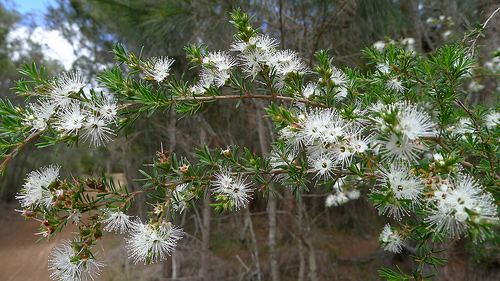
"Kunzea ambigua flowers" by John Tann. Licensed under CC BY 2.0
Description
Kunzea Essential Oil is sometimes referred to as White Cloud Essential Oil, Tasmanian Spring Flower Essential Oil and Tick Bush Essential Oil.
Native to Australia and Tasmania, Kunzea ambigua is a shrub that produces small, fragrant white flowers with intriguingly long stamens.
Kunzea Essential Oil is particularly helpful when incorporated into my personal blends for muscular and arthritic pain.
I see significant potential for use of Kunzea Essential Oil in emotional and physical applications. Robbi Zeck, ND, writes that Kunzea Essential Oil "helps to defuse deep emotional pain that has grown solid as a result of suppression, creating internal blocks in the body's meridian system." [Robbi Zeck, ND, The Blossoming Heart: Aromatherapy for Healing and Transformation (Victoria, Australia: Aroma Tours, 2008), 88.]
Aromatically, Kunzea Essential Oil is fresh, crisp and woody. Kunzea subtly reminds me of a combination of Eucalyptus and Fragonia, with perhaps a hint of Manuka.
Kunzea Essential Oil Benefits and Uses
- Respiratory Support
- Congestion
- Sinus Headaches
- Inflammation
- Sore Muscles
- Relaxation
- Insect Repellent
- Muscular Aches
- Joint Pain
- Nervous Tension
- Emotional Pain
- Emotional Blockages
Sources: Andrea Butje, The Heart of Aromatherapy (Carlsbad, CA: Hay House, Inc., 2017), 69. Robbi Zeck, ND, The Blossoming Heart: Aromatherapy for Healing and Transformation (Victoria, Australia: Aroma Tours, 2008), 88.
Botanical Name
Plant Family
Common Method of Extraction
Steam Distilled
Plant Part Typically Used
Color
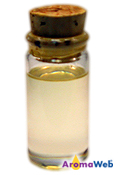
Clear to Pale Yellow
Consistency
Thin
Perfumery Note
Top to Middle
Strength of Initial Aroma
Strong
Aromatic Description
Kunzea Essential Oil smells fresh, crisp and woody.
Sustainability and Conservation Status
Not Evaluated by the IUCN Red List of Threatened Species
Source: IUCN Red List Search
Last Searched: February 15, 2026
To learn more about the conservation status of essential oil bearing plants and how to use the IUCN Red List of Threatened Species, please refer to AromaWeb's Guide to Essential Oils and Sustainability.
Major Constituents
- a-Pinene
- 1,8-Cineole
- Viridiflorol
- Globulol
- Bicyclogermacrene
- a-Terpineol
See Essential Oil Safety for a more complete list of typical constituents.
Source: Private Communication: Condon, 2003. Source cited in Robert Tisserand and Rodney Young, Essential Oil Safety (Second Edition. United Kingdom: Churchill Livingstone Elsevier, 2014), 468.
Kunzea Essential Oil Safety Information
Tisserand and Young warn that old and oxidized oils should not be used. Reading Tisserand and Young's full profile is recommended. [Robert Tisserand and Rodney Young, Essential Oil Safety (Second Edition. United Kingdom: Churchill Livingstone Elsevier, 2014), 468.]
General Safety Information
Do not take any oils internally and do not apply undiluted essential oils, absolutes, CO2s or other concentrated essences onto the skin without advanced essential oil knowledge or consultation from a qualified aromatherapy practitioner. For general dilution information, read AromaWeb's Guide to Diluting Essential Oils. If you are pregnant, epileptic, have liver damage, have cancer, or have any other medical problem, use oils only under the proper guidance of a qualified aromatherapy practitioner. Use extreme caution when using oils with children and be sure to first read the recommended dilution ratios for children. Consult a qualified aromatherapy practitioner before using oils with children, the elderly, if you have medical issues or are taking medications. Before using this or any essential oil, carefully read AromaWeb's Essential Oil Safety Information page. For in-depth information on oil safety issues, read Essential Oil Safety by Robert Tisserand and Rodney Young.
Shelf Life
Important Information About the Profiles
The essential oil information provided on AromaWeb is intended for basic educational purposes only. The references to safety information, test results, constituents and percentages is generalized information. Essential oils can vary greatly in composition. The data is not necessarily complete and is not guaranteed to be accurate. The essential oil photos are intended to represent the typical and approximate color of each essential oil. However, essential oil composition and color can vary based on harvesting, distillation, age of the essential oil and other factors. Profiles for several CO2 Extracts and absolutes are included within the directory, and are denoted as such.
Essential Oil Book Suggestions
Essential Oil Safety
Own Safety Profiles for 400 Essential Oils and 206 Constituents
Authors: Robert Tisserand and Rodney Young
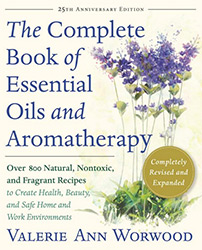
The Complete Book Of Essential Oils & Aromatherapy
Includes 125 Essential Oil Profiles
Author: Valerie Ann Worwood
Visit AromaWeb's Books area to find details about many other essential oil and aromatherapy books.