
Why Essential Oils Don't Mix With Water
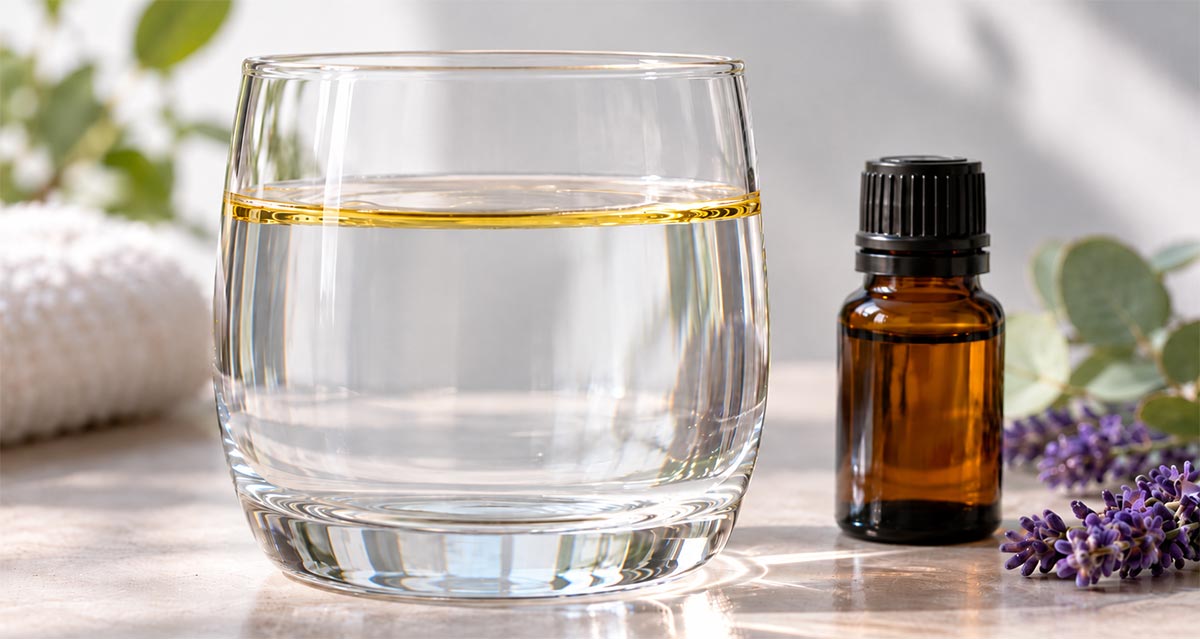
Table of Contents:
- The Short Answer: Essential Oils Are Not Water Soluble
- Why Do Essential Oils and Water Separate?
- Does Shaking Essential Oils With Water Work?
- Why This Matters for Essential Oil Safety
- How Can Essential Oils Be Mixed Into Water-Based Products?
- What Doesn't Reliably Disperse Essential Oils?
- Are Hydrosols Different?
- Frequently Asked Questions
- References and Further Reading
Essential Oils Are Not Water Soluble
If you add a few drops of essential oil to a glass of water, you will usually see droplets or a thin layer of oil at the surface. Stirring or shaking may temporarily break the oil into smaller droplets, but stirring or shaking does not make the essential oil truly water soluble.
This happens because water and essential oils possess different chemical properties that make it difficult for them to stay combined. Although some individual components of an essential oil can dissolve in small amounts, most of the oil remains separate from the water.1 The next section explains the chemistry behind this in more detail.
Knowing this matters when using essential oils, particularly in baths, body sprays and other water-based preparations. Because essential oils do not readily dissolve in water, concentrated droplets may remain in the mixture and come into direct contact with the skin, potentially causing irritation.
Why Do Essential Oils and Water Separate?
Water molecules have a slightly positive end and a slightly negative end. Chemists describe this as being polar. Water molecules attract one another through interactions called hydrogen bonds. Many essential oil constituents, including monoterpenes and sesquiterpenes, are nonpolar and cannot interact with water in the same way. That is why most of the oil stays separate.1,2
Other constituents, including alcohols, phenols, ethers, esters and aldehydes, contain polar functional groups, but this does not necessarily make them readily soluble in water.
You may have heard the expression "like dissolves like." It is a helpful introduction to solubility: substances with similar chemical characteristics are often more compatible as solvents and solutes.
However, essential oils are complex mixtures rather than single substances. Certain essential oil constituents, especially some that contain oxygen, can dissolve in water to a limited degree.1 As a result, it is more scientifically accurate to say that essential oils as mixtures are not readily water soluble than to claim that none of their individual constituents can dissolve in water.
Most essential oils are also less dense than water, so their droplets usually float. Some essential oils are denser than water and can sink instead. Floating or sinking is about density, not whether the oil can dissolve.1
Essential oils are generally described as lipophilic, meaning they have an affinity for fats and oils. The term is often explained as "oil-loving" because essential oils tend to dissolve more readily in oils than in water. They are also generally hydrophobic, meaning they have little affinity for water. Although hydrophobic is often translated as "water-repelling," it does not mean that essential oils actively push water away. Lipophobic means having little affinity for fats and oils, so it generally is not an appropriate description of essential oils.
Does Shaking Essential Oils With Water Work?
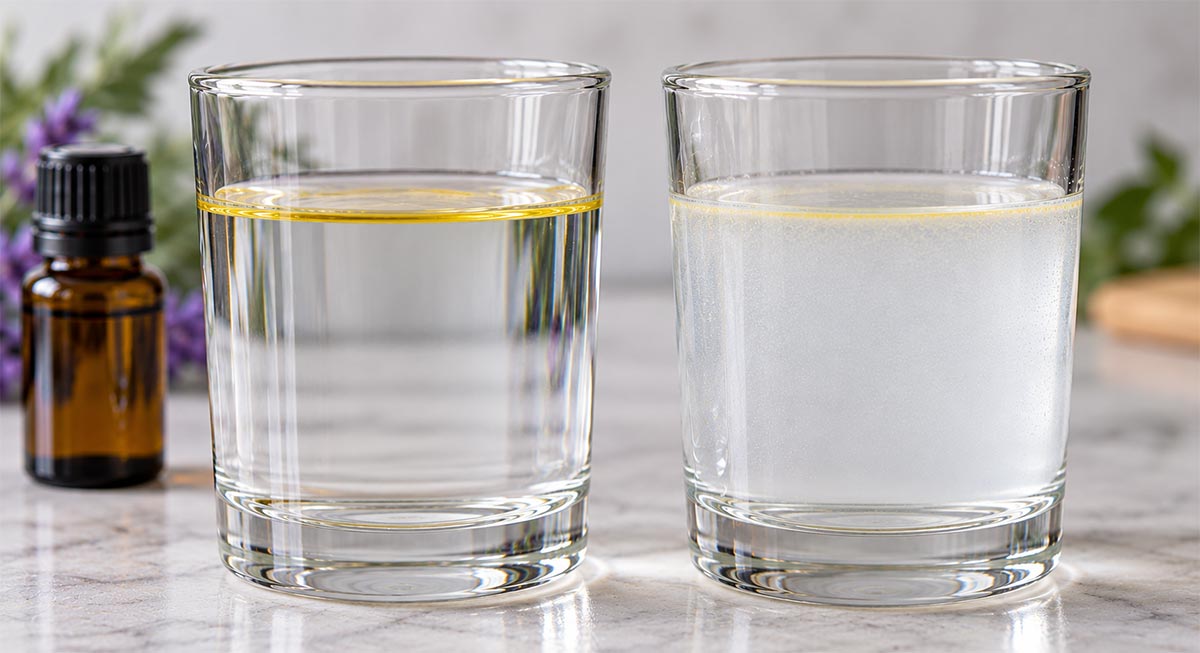
Shaking a bottle containing water and essential oil can temporarily break the oil into tiny droplets spread through the water. The mixture may look cloudy for a short time, but the oil has not truly dissolved.1
But a temporary dispersion is not the same as a stable solution. Without an appropriate solubilizer or emulsifying system, the droplets can merge and separate again. Shaking before each use does not guarantee that every spray or portion contains the same amount of essential oil.
Similarly, the fact that a mixture looks clear does not, by itself, prove that the formulation is stable, evenly solubilized or safe for its intended use.
Why This Matters for Essential Oil Safety
Essential Oils in Bathwater
Adding undiluted essential oils directly to bathwater is particularly concerning. Because the essential oil does not dissolve, concentrated droplets may come into direct contact with the skin, including sensitive areas. This can cause irritation and may contribute to adverse skin reactions.3,4
Epsom salts, ordinary bath salts and simply stirring the bathwater do not reliably solubilize essential oils. For guidance on suitable approaches, see AromaWeb's Aromatherapy Baths Guide.
Essential Oil Room Sprays and Body Sprays
A water-based spray made by combining water with drops of essential oil can separate in the bottle. This can lead to uneven distribution of the oil, including the possibility of spraying a more concentrated amount than intended.
For an appropriately formulated spray, a solubilizer compatible with the essential oil, water phase and intended application is generally needed. Skin-contact sprays also require consideration of safe essential oil concentrations and other formulation requirements.
Water-Based Products and Microbial Growth
Solubilizing essential oils does not preserve a water-based product. Microbial contamination and preservative requirements must be evaluated separately. Essential oils do not make a homemade water-based spray self-preserving.
How Can Essential Oils Be Mixed Into Water-Based Products?
The correct approach depends on the type of product you are making. Two helpful terms to know are solubilizer and emulsifier. Both can help combine oil and water, but they do not work in exactly the same way.
Solubilizers
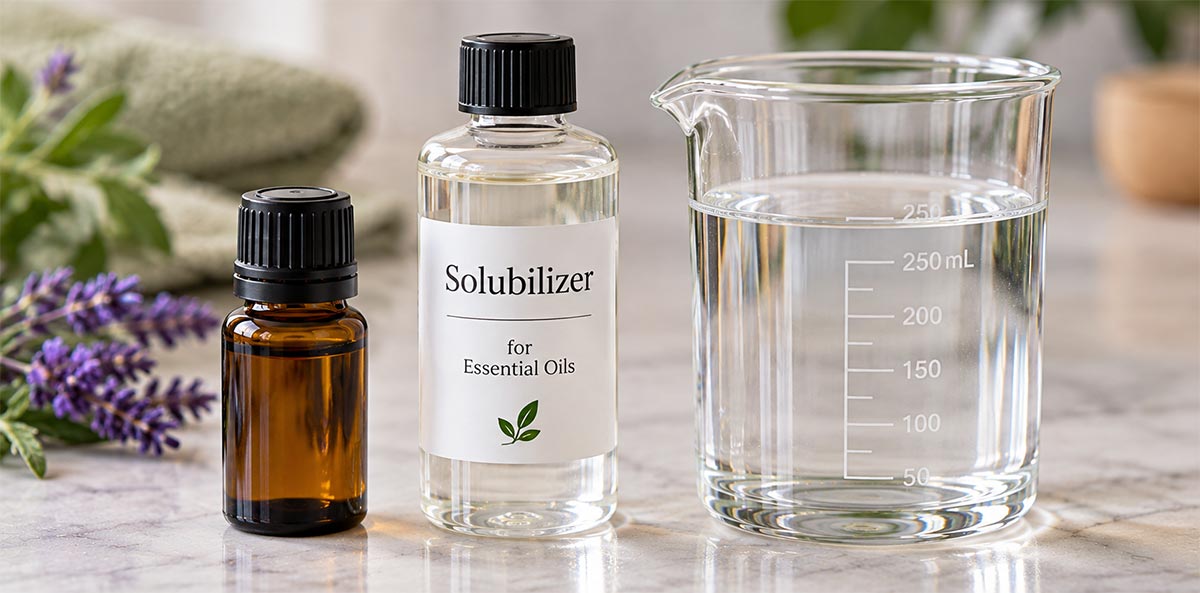
A solubilizer is an ingredient designed to help incorporate small amounts of an oil-soluble substance, such as essential oil, into a water-based formula. Depending on the ingredients and proportions, a suitable solubilizer may produce a clear or nearly clear preparation.
Examples used in some aromatherapy formulations include Polysorbate 20 and products marketed as Solubol. These ingredients are not necessarily interchangeable. Follow the manufacturer's usage directions and suitability guidance for the exact product and application. A ratio that works for one essential oil blend may not work for another.
Emulsifiers and Dispersants
An emulsifier helps stabilize a mixture of oil and water in which one liquid is distributed as droplets within the other. An emulsion may appear milky rather than clear. Emulsifiers have parts that interact with water and parts that interact with oil, helping keep the droplets distributed throughout the mixture.1 Dispersant is a broader term sometimes used for ingredients that help distribute essential oils through another medium.
Not every emulsifier will create a clear water-based spray, and not every solubilizer or dispersant is suitable for bath products or topical applications. Product-specific instructions and formulation testing matter.
If you are making a water-based product from scratch, select ingredients intended for that type of formulation rather than assuming that any substance which temporarily clouds the water will adequately disperse essential oils.
 -
What Doesn't Reliably Disperse Essential Oils in Water?
Several common ingredients are mistakenly described as ways to make essential oils water soluble:
- Epsom salts and other salts: The salts may dissolve, but that does not mean the essential oil does.
- Baking soda: It does not act as a dependable essential oil solubilizer.
- Witch hazel: Its ability to incorporate essential oil depends on the specific formulation, including its alcohol content. It should not be assumed to be an effective solubilizer.
- Milk: Adding essential oils to ordinary milk does not reliably create a safe, uniform bath dispersion.3,4
- Carrier oils: Essential oils can usually be diluted in suitable vegetable carrier oils, but the resulting oil blend still does not dissolve in water.
- Shaking or stirring: Agitation alone cannot provide lasting solubilization.
Alcohol is a more nuanced case. Essential oils may dissolve in an appropriate concentration and amount of ethanol (the alcohol used in perfumes), but adding water can make the mixture turn cloudy or separate. The result depends on how much alcohol and water are present and which essential oil is used. A small splash of alcohol does not automatically make an essential oil and water mixture stable.1
Are Hydrosols Different From Essential Oils Mixed With Water?
Yes. A hydrosol is not simply water with drops of essential oil stirred into it. As Suzanne Catty explains, hydrosols are the aromatic water collected during the steam- or hydro-distillation of plant material. They contain small amounts of naturally occurring water-soluble aromatic constituents and are different from water to which drops of essential oil have been added.5
Because hydrosols are primarily water, their composition and handling differ from those of concentrated essential oils. Hydrosols can also be susceptible to microbial contamination and require appropriate handling and storage.
Learn more in AromaWeb's What Are Hydrosols? guide.
Frequently Asked Questions
Can Essential Oils Dissolve in Water?
As complete mixtures, essential oils are generally poorly soluble in water. Some individual essential oil constituents dissolve to a limited extent, but most of the oil will not form a uniform solution when you add drops directly to water.
Why Does My Essential Oil Float on Water?
Most essential oils are less dense than water, so undissolved droplets tend to collect at the surface. A few essential oils have higher densities and may behave differently.
Is It Safe to Put Essential Oils Directly Into a Bath?
No. Undiluted droplets can come into contact with the skin and cause irritation. Use a product and formulation method specifically suitable for an aromatic bath rather than adding essential oil straight to bathwater.3,4
Can I Just Shake My Essential Oil and Water Spray Before Each Use?
Shaking may temporarily distribute the essential oil, but it cannot ensure an even concentration in each spray. For a stored water-based formulation, appropriate solubilization, stability and preservation need to be considered.
Does Adding a Carrier Oil Make Essential Oils Water Soluble?
No. A suitable carrier oil can dilute an essential oil for certain applications, but that oil mixture will still separate from water unless the formulation also contains an appropriate emulsifying or solubilizing system.
References and Further Reading
1 E. Joy Bowles, The Chemistry of Aromatherapeutic Oils, 3rd ed. (2004), 42-49, especially 45-49 (polarity, essential oil solubility in water and ethanol, and emulsification).
2 David G. Williams, The Chemistry of Essential Oils, 2nd ed. (Micelle Press), 125-126 (water polarity and hydrogen bonding).
3 Hana Tisserand, "Bath Safety II: Dispersing Essential Oils," Tisserand Institute. Accessed October 2026.
4 Hana Tisserand, "Bath Safety," Tisserand Institute. Accessed October 2026.
5 Suzanne Catty, Hydrosols: The Next Aromatherapy (Rochester, VT: Healing Arts Press, 2001), 10 (definition of hydrosols).
General Safety Information
Do not take any oils internally and do not apply undiluted essential oils, absolutes, CO2s or other concentrated essences onto the skin without advanced essential oil knowledge or consultation from a qualified aromatherapy practitioner. For general dilution information, read AromaWeb's Guide to Diluting Essential Oils. If you are pregnant, epileptic, have liver damage, have cancer, or have any other medical problem, use oils only under the proper guidance of a qualified aromatherapy practitioner. Use extreme caution when using oils with children and be sure to first read the recommended dilution ratios for children. Consult a qualified aromatherapy practitioner before using oils with children, the elderly, if you have medical issues or are taking medications. Before using this or any essential oil, carefully read AromaWeb's Essential Oil Safety Information page. For in-depth information on oil safety issues, read Essential Oil Safety by Robert Tisserand and Rodney Young.
Shelf Life
Important Information About the Profiles
The essential oil information provided on AromaWeb is intended for basic educational purposes only. The references to safety information, test results, constituents and percentages is generalized information. Essential oils can vary greatly in composition. The data is not necessarily complete and is not guaranteed to be accurate. The essential oil photos are intended to represent the typical and approximate color of each essential oil. However, essential oil composition and color can vary based on harvesting, distillation, age of the essential oil and other factors. Profiles for several CO2 Extracts and absolutes are included within the directory, and are denoted as such.
Essential Oil Book Suggestions

Essential Oil Safety
Own Safety Profiles for 400 Essential Oils and 206 Constituents
Authors: Robert Tisserand and Rodney Young
The Complete Book Of Essential Oils & Aromatherapy
Includes 125 Essential Oil Profiles
Author: Valerie Ann Worwood
Visit AromaWeb's Books area to find details about many other essential oil and aromatherapy books.