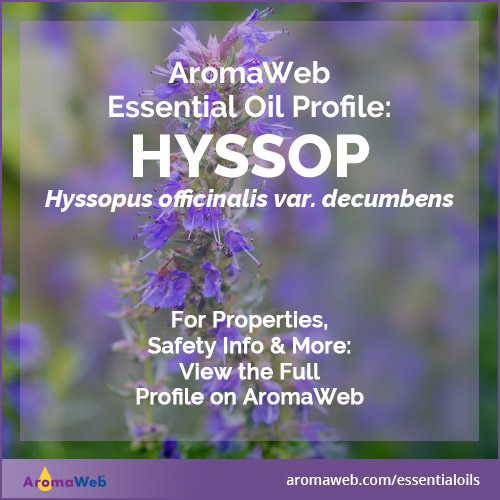
Hyssop Essential Oil
Hyssopus officinalis var. decumbens

Description
Hyssop Essential Oil is a beautiful essential oil to work with for respiratory issues and can also be helpful for digestion and muscular and joint pain.
However, when working with Hyssop Essential Oil, it's especially important to purchase the oil from a reputable supplier. It is an essential oil that requires greater care and understanding when purchasing and using the oil. Hyssop Essential Oil is most commonly available with the botanical names of Hyssopus officinalis var. decumbens and Hyssopus officinalis. Generally speaking, Hyssop Essential Oil that does not include the var. decumbens portion of the botanical name contain significantly more of the ketone Pinocamphone and is much riskier to use. See the Hyssop Essential Oil Safety Info section below for more information.
Aromatically, Hyssop Essential Oil is fresh, earthy, fruity, woody, slightly sweet and camphorous. It blends best with essential oils in the citrus, floral, wood, herbal and medicinal families.
For emotional and spiritual applications, Valerie Ann Worwood says that Hyssop "...purifies and cleanses, awakening closed hearts and minds, bringing tolerance and understanding, unconditional love and acceptance, and the comprehension needed for the ultimate oneness with the universe." [Valerie Ann Worwood, Aromatherapy for the Soul (Novato, CA: New World Library, 1999, 237.]
Hyssop Essential Oil Benefits and Uses (Specifically for Hyssop Officinalis var decumbens)
- Coughs
- Colds
- Influenza
- Bronchitis
- Catarrh
- Asthma
- Bronchial Infections
- Contusions
- Bruising
- Wounds
- Arthritis
- Rhematism
- Muscular Aches and Pains
- Digestive Problems
Source: Valerie Ann Worwood, The Complete Book of Essential Oils and Aromatherapy, 25th Anniversary Edition (Novato, CA: New World Library, 2016, 548.
Botanical Name
Hyssopus officinalis var. decumbens
Plant Family
Common Method of Extraction
Steam Distilled
Plant Part Typically Used
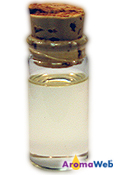
Color
Clear to Pale Yellow
Consistency
Thin
Perfumery Note
Middle
Strength of Initial Aroma
Medium
Aromatic Description
Hyssop Essential Oil smells fresh, earthy, fruity, woody, slightly sweet and camphorous.
Major Constituents of Hyssop officinalis var decumbens
- Linalol
- 1,8-Cineole
- (+)-Limonene
- Gamma-Pinene
- Caryophyllene Oxide
See Essential Oil Safety for a more complete list of typical constituents.
Source: G. Salvatore, A. D'Andrea, M. Nicolette, A pinocalphone Poor Oil of Hyssopus officinalis L. var decumbens from France (Banon) (Journal of Essential Oil Research 10, 1998), 563-567. Source cited in Robert Tisserand and Rodney Young, Essential Oil Safety (Second Edition. United Kingdom: Churchill Livingstone Elsevier, 2014), 307.
Major Constituents of Hyssop officinalis
Pinocamphone
Isopinocamphone
B-Pinene
Myrtenyl methyl ether
Myrteno
Thujone
See Essential Oil Safety for a more complete list of constituents.
[Sources cited in B.M. Lawrence, Essential Oils 1981-1987 (Wheaton: Allured Publishing, 1989), 110. B.M. Lawrence, Progress in Essential Oils. (Perfumer & Flavorist 23 no. 3, 1999), 58-60. Robert Tisserand and Rodney Young, Essential Oil Safety (Second Edition. United Kingdom: Churchill Livingstone Elsevier, 2014), 308.]
Hyssop Essential Oil Safety Information
Hyssopus officinalis var. decumbens
Tisserand and Young do not indicate any special precautions for Hyssop Essential Oil that possesses the botanical name Hyssopus officinalis var. decumbens and that contains under 1% Pinocamphone. It is very important to be certain of the chemotype essential oil that you are working with.
Hyssopus officinalis and Hyssop Essential Oils High in Pinocamphone
Tisserand and Young strongly precaution to avoid Hyssop Essential Oil with the chemotype of pinocamphone during pregnancy and breastfeeding and to avoid use with children 2 years and younger. They recommend a dermal maximum of 0.3% for Hyssop Essential Oil (that percentage is based on oils containing 82.3% pinocamphone). Though AromaWeb does not cover or provide specific safety information for the internal use of essential oils, it should be noted that Tisserand and Young emphasize that Hyssop Oil should not be used internally. Reading Tisserand and Young's full profile is recommended. [Robert Tisserand and Rodney Young, Essential Oil Safety (Second Edition. United Kingdom: Churchill Livingstone Elsevier, 2014), 308.]
General Safety Information
Do not take any oils internally and do not apply undiluted essential oils, absolutes, CO2s or other concentrated essences onto the skin without advanced essential oil knowledge or consultation from a qualified aromatherapy practitioner. For general dilution information, read AromaWeb's Guide to Diluting Essential Oils. If you are pregnant, epileptic, have liver damage, have cancer, or have any other medical problem, use oils only under the proper guidance of a qualified aromatherapy practitioner. Use extreme caution when using oils with children and be sure to first read the recommended dilution ratios for children. Consult a qualified aromatherapy practitioner before using oils with children, the elderly, if you have medical issues or are taking medications. Before using this or any essential oil, carefully read AromaWeb's Essential Oil Safety Information page. For in-depth information on oil safety issues, read Essential Oil Safety by Robert Tisserand and Rodney Young.
Shelf Life
Important Information About the Profiles
The essential oil information provided on AromaWeb is intended for basic educational purposes only. The references to safety information, test results, constituents and percentages is generalized information. Essential oils can vary greatly in composition. The data is not necessary complete and is not guaranteed to be accurate. The essential oil photos are intended to represent the typical and approximate color of each essential oil. However, essential oil composition and color can vary based on harvesting, distillation, age of the essential oil and other factors. Profiles for several CO2 Extracts and absolutes are included within the directory, and are denoted as such.