Guide to Diluting Essential Oils
Undiluted Use of Essential Oils On the Skin Can Be Harmful and Potentially Cause Severe Irritation or Sensitization.
I often come across statements from aromatherapy authors and educators mistakenly claiming that certain essential oils, especially lavender and tea tree, can be applied directly to the skin without dilution. However, it is important to always dilute essential oils in a carrier oil to minimize the risk of irritation and adverse reactions.
Using essential oils on the skin without diluting them is referred to as applying them "neat."
Never Put Undiluted Essential Oils On Your Skin.
Not even lavender or tea tree.
Always dilute essential oils adequately prior to applying them to your skin, scalp or hair.
There are instances when experienced aromatherapy practitioners make exceptions to this precaution. Only once significant essential oil knowledge is gained should you ever attempt to apply any undiluted essential oil on the skin.
I have been a part of the aromatherapy community for over 25 years. Occasionally, I hear about those that have used undiluted essential oils and have developed permanent sensitization, even by only using a single drop of lavender essential oil per use. It's really not worth the risk. Diluting your essential oils adequately not only helps to protect your wellbeing, it can also save you money.
Marge Clark shares her experience with sensitization in her book Essential Oils and Aromatics. Marge shares her experience and her unfortunate long term consequences for having used undiluted lavender essential oil:
"One of my mentors reminds me 'sensitization is forever.' And I know she is right. Years ago I read the books saying that lavender oil could be used neat (undiluted). I very unwisely used undiluted lavender on broken skin, and consequently set up a sensitivity reaction. Today, almost two decades later, if I come in contact with lavender in any form, I will immediately start a new round of contact dermatitis that can take months to heal." [Marge Clark, Essential Oils and Aromatics (Sandy, UT: Silverleaf Press, 2008), 32.]
What is Sensitization?
The symptoms of sensitization can vary from individual to individual, but think of it like a skin allergy that results in a severe and/or itchy rash. More severe cases of sensitization can potentially lead to respiratory issues or apparently even anaphylactic shock. Once you develop sensitization to an essential oil, you are likely to remain permanently sensitized to that essential oil, even if you begin to adequately dilute it. You may also develop a reaction to other essential oils as well and will also experience reactions to products that contain these oils.
Treat Essential Oils With Respect
Treat essential oils with the same care that you treat medicines. You don't need to be afraid or avoid essential oils and I'm certainly not trying to scare anyone out of enjoying all the benefits that aromatherapy offers. They can be an amazing blessing within a holistic lifestyle. Do remember, however, that when working with essential oils, less is more.
Dilute your essential oils adequately prior to use on the skin and use extreme caution with oils that are more likely to cause irritation and sensitization. Remember that even if you've been using one or more essential oils undiluted to date and you haven't had a problem, that doesn't guarantee that you won't develop sensitization with repeated exposure. Proper dilution is always recommended.
Essential Oils More Likely To Cause Dermal Irritation
Read AromaWeb's Essential Oils That May Cause Dermal Irritation and Skin Sensitization article to learn which oils need to be used with much greater caution in topical applications.
How to Dilute Your Essential Oils for Topical Use
Using a 2% essential oil dilution is generally considered a safe guideline for topical application of essential oils on adults when an essential oil has a dermal maximum of 2% of higher as provided within the second edition of Essential Oil Safety by Robert Tisserand and Rodney Young. If the dermal maximum for an esssential oil is below 2%, it is important that you do not exceed the dermal maximum. For children or elderly, use only a 1% dilution. With children, use only essential oils regarded as safe for children.
For the Essential Oil Profiles that are available on AromaWeb, Tisserand and Young's dermal maximum guidelines are cited where possible. Essential Oil Safety contains a lot of supplementary profile information that is recommended reading, so it's very helpful to refer directly to the book for complete dermal usage and safety information.
Many individuals have become accustomed to heavily scented commercial fragrances, lotions, cosmetics, soaps and room fresheners fragranced primarily with synthetics. The aroma of a 2% dilution may seem weak or barely aromatic at first. If you're used to strongly scented products, be assured that over time, you will begin to adjust and savor the nuances of your diluted blends. For more information, read Safely Diluted Essential Oil Blends May Smell Weak At First.
The Easiest Way to Make a 2% Dilution
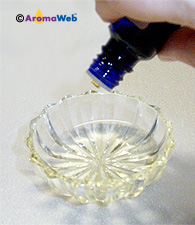
When working with small quantities of essential oils for your own personal use, the easiest way to measure is by the drop. Unfortunately, one drop of one essential oil may be bigger or smaller than another because of the viscosity and temperature of the oil and the size of the dropper or orifice reducer. As such, measuring by the drop is not the most accurate method of measuring essential or carrier oils, but it is generally okay for creating small topical blends and recipes for your own, personal use. The most accurate way of measuring is by weight, not by-the-drop or by volume. Measuring by weight is recommended for more precise blending and accuracy. Since most of those referring to this article are new to working with essential oils and don't have familiarity with measuring out tiny amounts of essential oils by weight, this article focuses upon measurement by the drop.
A good rule of thumb when seeking to make a 2% dilution using the by-the-drop method is to add 12 drops of essential oil to each fl. ounce (30 ml) of cold pressed carrier oil, lotion, vegetable butter or other natural lipid/moisturizer.
On average, based on my testing with different orifice reducers, pipettes, droppers and oils of varying thicknesses, 600 drops of essential oil equals 30ml or 1 fl. ounce - on average. However, some aromatherapy experts and educators that I highly respect do specify that the number of drops per ounce from their own experiences and testing is different. I hesitate to concede as I prefer to be more conservative when presenting this information to so many aromatherapy newcomers, so I continue to stick with my 600 drops per ounce basis.
2% of 600 drops equals 12 drops (600x.02). However, as I keep emphasizing, this can vary greatly depending upon the size and type of pipette, dropper or orifice reducer used and the viscosity (thickness) of the particular essential oil.
To easily approximate a 2% dilution, add 12 drops of your chosen essential oil to 1 fl. oz (30ml) of carrier oil. Technically, this method of measurement is not entirely precise — 2% essential oil should be added to only 98/100th of an ounce of carrier, but adding it to a full ounce makes this so much easier for most individuals to measure.
Question: How Do I Work With an Essential Oil Has a Dermal Maximum Recommendation That Is Less than 2%?
Do not use an essential oil above its recommended dermal maximum. The same type of calculation described above can be used as the basis for working with oils that have different dermal usage maximums. For instance, if Essential Oil Safety recommends a dermal maximum of 0.7% for a particular essential oil like Lemongrass Oil, multiply 600 drops (the average number of drops in an ounce) by 0.007 (this is the decimal version of 0.7%), resulting in a maximum recommendation of 4.2 drops per ounce, and that should be rounded down to 4 drops per ounce.
Question: Do I Need To Dilute Essential Oils If I Use Them In My Diffuser?
When using essential oils in your diffuser, please follow the directions that come with your particular type or model diffuser. There are a limitless number of diffusers on the market these days, so you need to be sure to check the directions that accompany the brand and model that you have.