Aromatherapy Candles
I first began exploring aromatherapy over two decades ago. My original assumption was that candles held a prominent place in aromatherapy. They are a practical yet beautiful light/heat source, and candles can be so wonderfully aromatic.
They add a beautiful, ambient touch to a romantic evening, help add an air of relaxation and calmness at bath time and provide a sense of comfort. Candles are used in religious ceremonies, in meditation and in so many other applications where a sense of enlightenment, relaxation or calm is sought.
Why then, do candles have a more limited role in holistic aromatherapy despite the word aromatherapy being so frequently and prominently used in the marketing of major commercial candle brands?
Answer: There's no law or guidelines available regarding the use of the term "aromatherapy." Any manufacturer, even those that include synthetic ingredients in their candles, can slap the word "aromatherapy" onto their label.
Holistic aromatherapy focuses and emphasizes the use of all natural ingredients whenever possible. Many candles are not all natural, even if they are marketed with the word aromatherapy. If you burn candles made with synthetic ingredients (or even natural ingredients with toxic compounds), despite how pleasantly fragrant the air is that you breathe, you will still inhale toxins.
Candles suitable for use in true aromatherapy are available, but they are harder to find and are generally are more costly.
Several reasons for this exist:
The Choice of Wax Used to Produce the Candles
Candles made with waxes that emit toxins when burned (i.e. paraffin) are cheaper, but they aren't suitable for holistic aromatherapy. Paraffin wax is a by-product of petroleum production.
Beeswax, soy, and other vegetable based waxes are the waxes of choice by those who are environmentally conscious and by those involved in aromatherapy. Those wishing to produce natural candles face several challenges because of pros and cons of each wax and the higher cost of each wax. Soy, for instance is a soft wax. Aside from small votives and tea lights, larger soy based candles are usually available only as larger container candles. Beeswax is a much firmer wax, but is expensive and has its very distinctive but pleasant honey-like aroma and color.
The Large Quantity Essential Oil Required to Make Aromatic Candles
I have repeatedly been informed that it requires a significant amount of essential oil in order for the fragrance of the essential oil to be detectable in the candle. As a result, most candles on the market use synthetic fragrance oils. The same holds true for bar soap manufacture, though it's easier to find all-natural bars of soap than it is to find all-natural candles fragranced only with essential oils.
Colorants Included In the Candles
Aside from a single day course in beeswax candle making, I haven't actively made candles, and I cannot personally comment on what natural colorant options are available to candle makers. Several brightly colored herbs and fruit fibers may work successfully when blended with natural waxes and burned. I, however, would recommend using caution when purchasing brightly colored candles that do not list the ingredients.
When you see displays of colorful and highly fragrant candles in department stores, specialty stores and even in health-conscious stores, it's not uncommon to find the word "aromatherapy" used on candles that are fragranced with fragrance oils and/or use paraffin wax.
Use caution when purchasing candles that do not clearly list all of the ingredients used within the candle. Most candles don't, and for good reason. Not many manufacturers want you to know that their candles contain synthetic ingredients. Remember that "Made With Essential Oils" doesn't mean a whole lot. The candle can still contain mostly fragrance oils. The same holds true with "Made With Beeswax." The candle can still contain mostly paraffin wax.
What to Look For When Shopping for Natural Candles
When shopping for natural candles suitable for aromatherapy, carefully read the labels. Pay attention to the type of waxes included in the candle. Also confirm that the candle is fragranced only with essential oils and not fragrance oils or other synthetics.
The makers of all natural candles or nearly all natural candles usually promote that their candles are all natural. Remember that "Made with XYZ" doesn't mean the candle is all natural. Look for candle makers that list their ingredients and promote their candles with statements similar to the following:
- "Made With 100% Natural Ingredients"
- "Contains No Synthetic Ingredients"
- "Fragranced Exclusively With Essential Oils"
- "Made Exclusively With Soy Wax"
- "Contains No Fragrance Oils"
- "Paraffin Wax Free"
Candle Alternatives and Ideas
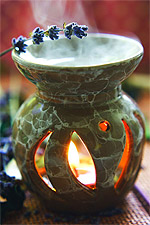
Because natural candles fragranced with essential oils are costly, consider using an essential oil diffuser and soy based unscented beeswax, soy or other natural vegetable based tea light candles:
On the left is a photo of an essential oil diffuser that utilizes a single tea light candle as the heat source. Visit the Web sites of AromaWeb's banner advertisers and the Diffusers and Nebulizers section of the Aromathearpy Business Directory. Unscented beeswax and soy-based tea light candles are readily available. By using the diffuser with a single tea light candle, you can affordably enjoy the aromas of your favorite essential oil or essential oil blend. If you prefer the ambiance of multiple candles, burn several natural, unscented pure beeswax or soy candles while enjoying the aroma emitted from the diffuser.